Star S301 sets speed record near Milky Way's central black hole
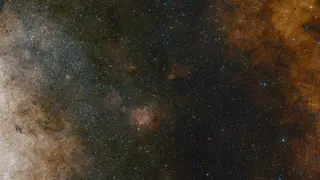
Astronomers discovered a star named S301 near the Milky Way's center, reaching speeds over 8% of light speed. At closest approach, it comes within 1.8 billion kilometers of the supermassive black hole Sagittarius A*, ten times closer than any known star. Its extreme orbit may allow unprecedented tests of gravity, including frame-dragging effects.
The discovery relied on years of precise tracking with the Very Large Telescope in Chile, with observations beginning in 2023 before the orbit could be confirmed. At its closest point, S301 passes within 1.8 billion kilometers of Sagittarius A*, a distance roughly twelve times the Earth-sun separation. This proximity places the star in a region where space-time is dramatically warped by the black hole's rotation, an effect known as frame-dragging. Researchers compare the star to a leaf dropped in wind, revealing how space-time itself moves. Black holes possess only three measurable properties—mass, spin, and possibly charge—and the mass measurement alone earned a Nobel Prize in 2020, underscoring how significant a spin measurement would be.
This finding could reshape fundamental physics by enabling the first direct measurement of a supermassive black hole's spin, which may confirm or challenge existing theories of gravity in extreme conditions. Scientists and research institutions could gain new tools for testing general relativity, while the broader public may find renewed interest in cosmic mysteries. Educational programs and science communication could benefit from such a dramatic discovery, potentially inspiring future generations of astronomers and physicists. However, practical societal impacts remain distant, as the research timeline spans roughly a decade.