Roman telescope to block starlight for direct exoplanet imaging
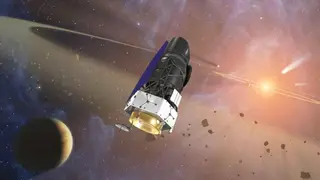
NASA's Nancy Grace Roman Space Telescope, launching August 30, 2026, will use a coronagraph to block starlight, enabling direct observation of exoplanets. Its mirror is similar in size to Hubble's but shaped to provide a much wider field of view. This advanced planet-imaging technology is expected to dramatically increase the number of directly imaged alien worlds.
Roman’s coronagraph uses multiple shaped masks to suppress starlight far more effectively than the simple metal disks of early solar observations. Its mirror, though similar in size to Hubble’s, is curved differently to capture a field of view 100 times wider, letting the Wide Field Instrument survey billions of galaxies for dark energy studies. The CGI camera works alongside this, targeting nearby bright stars to catch faint planetary points of light. Because planets can be millions to billions of times dimmer than their stars, this technology represents a major leap in direct imaging capability.
Directly imaging exoplanets could reshape how the public and scientists understand planetary systems, offering visual proof of worlds beyond our solar system. This may accelerate interest in habitability research and inspire future missions, but it also raises expectations about finding Earth-like planets that may not be immediately confirmed. The technology’s success could influence funding priorities and international collaboration, though its immediate societal impact likely remains within scientific and educational spheres.